
Georgia Uses Superior Court as Its Trial Court of General Jurisdiction
The official Superior Court page is gwinnettcourts.com/superior. Superior Court is the court that handles the most serious and the most complex cases in Gwinnett. Civil cases that require jury trials in felony, divorce, equity, and land title matters belong here. State Court takes most misdemeanor and traffic misdemeanor matters, and Magistrate Court handles small claims and dispossessory work.
Most Superior Court files are public unless a statute, a sealing order, or a privacy rule blocks access. Search the Tyler Odyssey portal at portal-gagwinnett.tylertech.cloud for the public index.
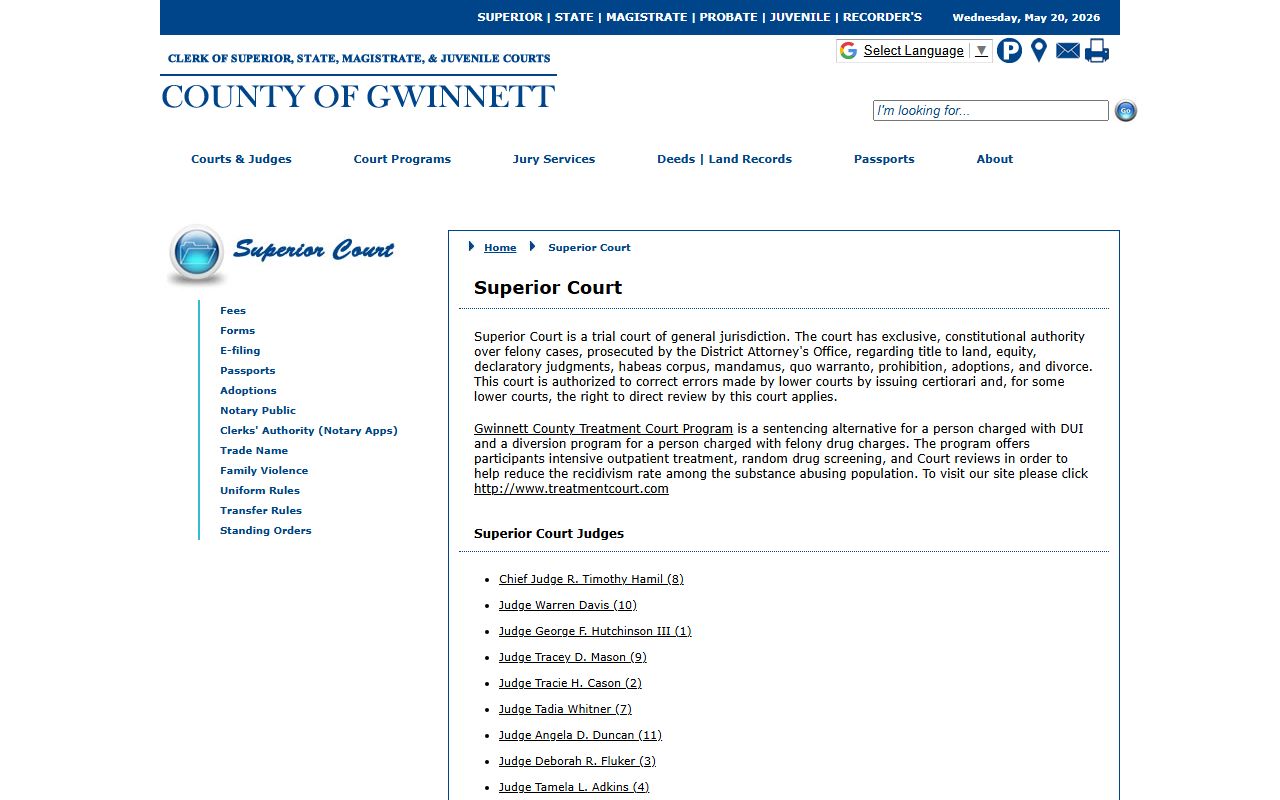
The Superior Court page lists judges, divisions, calendars, and forms tied to the court's daily work.
Gwinnett Superior Court Jurisdiction
Superior Court has the broadest trial jurisdiction in Georgia. The case types below show up most often.
- Felonies, including violent crime, drug, theft, and property charges.
- Divorce, custody, child support, and contempt cases.
- Equity and injunction matters.
- Land title cases, including quiet title and ejectment.
- Adoptions where assigned by law.
- Name changes.
- Higher value civil cases.
- Some appeals from lower tribunals.
Superior Court can run jury trials and issue injunctions. It cannot resolve every case alone, since some matters belong with Probate, Juvenile, Magistrate, State, or Recorder's Court.
Gwinnett Trial Courts at a Glance
Each trial court keeps its own role. The table below shows the main court types in the county, with addresses and contact points.
| Court | Role | Address | Page |
|---|---|---|---|
| Superior Court | Felony, divorce, equity, land title | 75 Langley Dr, Lawrenceville | gwinnettcourts.com/superior |
| State Court | Misdemeanor, civil, traffic misdemeanors | 75 Langley Dr, Lawrenceville | gwinnettcourts.com/state |
| Magistrate Court | Small claims, dispossessory, warrants, first appearances | 75 Langley Dr, Lawrenceville | gwinnettcourts.com/magistrate |
| Probate Court | Estates, marriage, guardianship, vital records | 75 Langley Dr, Lawrenceville | gwinnettcourts.com/probate |
| Juvenile Court | Juvenile delinquency, dependency, CHINS | 75 Langley Dr, Lawrenceville | gwinnettcourts.com/juvenile |
| Recorder's Court | County traffic, code, ordinance | 75 Langley Dr, Lawrenceville | gwinnettcourts.com/recorder |
| Municipal Courts | City ordinance and traffic cases | City-specific | Use each city court page |
Superior Court vs State Court vs Magistrate Court
Many Gwinnett users mix up the three biggest trial courts. The table below sums up the differences.
| Topic | Superior Court | State Court | Magistrate Court |
|---|---|---|---|
| Main Case Types | Felony, divorce, equity, land title | Misdemeanor, civil, traffic misdemeanors | Small claims, dispossessory, warrants |
| Jury Trials | Yes, including felony juries | Yes, in eligible cases | Limited or none |
| Records Custodian | Clerk of Courts | Clerk of Courts | Clerk of Courts |
| Filing Volume | Heavy in felony and family work | Heavy in misdemeanor and civil work | Highest volume in housing and small disputes |
| Bond and First Appearance | Felony bond when allowed | State Court bond when allowed | Magistrate first appearance after arrest |
How a Case Moves Through the Gwinnett Court System
Cases follow a typical path. The exact steps depend on the case type, but the flow below is common in Gwinnett.
Criminal case flow: Arrest › Magistrate first appearance › bond decision › State Court (misdemeanor) or Superior Court (felony) › arraignment › motions › plea or trial › sentence › appeal to the Court of Appeals of Georgia.
Civil case flow: Complaint filed › service › answer › discovery › motions › mediation or settlement › trial › judgment › appeal.
Family case flow: Complaint or petition › service › temporary hearing › financial disclosures › parenting plan or child support › mediation › final decree.
Specialty Courts in Gwinnett
Gwinnett uses Georgia's accountability court framework for problem solving programs. Drug court, mental health court, and veterans treatment programs may be available through the Superior or State Court system. Eligibility usually requires a qualifying criminal case, a clinical review, prosecutor and defense input, and judicial approval. Completion can reduce jail exposure and improve case results. Confirm program status through the Superior Court page before applying.
Appeals From Gwinnett Trial Courts
Appeals from Superior Court generally go to the Court of Appeals of Georgia, and some case types go directly to the Supreme Court of Georgia. Appeals from State Court, Magistrate Court, and Recorder's Court can move through Superior Court or other paths depending on the case. The Georgia Constitution and statutes set the route. For statewide judicial information, see the Administrative Office of the Courts page.
The Administrative Office of the Courts publishes statewide rules, forms, and resources that frame Gwinnett's appeals path.
Federal Courts From Gwinnett
Federal cases from Gwinnett do not get filed in Superior Court. They go to the U.S. District Court for the Northern District of Georgia. Bankruptcy cases go to the U.S. Bankruptcy Court for the Northern District of Georgia. Federal appeals go to the U.S. Court of Appeals for the Eleventh Circuit. The official federal docket is on PACER, with electronic filing on CM/ECF.
Prosecutors and Defense in Superior Court
The Gwinnett County District Attorney's Office at gwinnettcounty.com/departments/districtattorney prosecutes felony cases in Superior Court. DA Patsy Austin-Gatson leads the office. The office runs trial, investigative, appellate, victim services, and specialized prosecution divisions. The Solicitor-General prosecutes misdemeanor matters that route to State Court.
Defendants who cannot afford counsel can ask for court appointed counsel through the Georgia Public Defender Council process. Indigent defense in Superior Court generally starts at or before arraignment, with a financial review at intake. For private referrals, see the State Bar of Georgia or the Gwinnett County Bar Association.
The Gwinnett Court Campus in Lawrenceville
The Gwinnett Justice and Administration Center, often called the GJAC, sits at 75 Langley Drive in Lawrenceville. It is a multi-court justice campus rather than a single court building. The Clerk of Courts, the District Attorney's Office, the Solicitor-General, the Sheriff's court security, jury services, probation, and county administration all sit near the courts. Visitors should expect security screening before entering courtroom areas.
Gwinnett Justice and Administration Center
75 Langley Drive
Lawrenceville, GA 30046
The Gwinnett Judicial Circuit and the Ninth District
Gwinnett is its own single-county circuit, the Gwinnett Judicial Circuit, and sits inside the Ninth Superior Court District. The Chief Judge and the other Superior Court judges share felony, civil, family, and equity caseloads. Specific judicial assignments and divisional rotations show on the official Superior Court page and on the court's calendar pages.
Visitors with hearings should check the courtroom and the judge name on the hearing notice. The campus has multiple courtrooms, and arriving at the wrong floor can cause a missed call. The bailiff and the calendar clerk on duty can usually point a visitor to the right room when needed.