
The Role of Gwinnett Probate Court
The official page is gwinnettcourts.com/probate. Probate Court handles a broad set of life-event filings beyond estates. The marriage license page sits at gwinnettcounty.com/departments/probatecourt/marriagelicenses. Estate filings sit at gwinnettcounty.com/departments/probatecourt/estates. Guardianship and conservatorship work sits at gwinnettcounty.com/departments/probatecourt/guardianshipsandconservatorships. The fees page sits at gwinnettcounty.com/departments/probatecourt/fees.
Probate Court is a separate court in Georgia. It should not be confused with the Clerk of Courts, which handles Superior, State, Magistrate, and Recorder's Court records.
Gwinnett Estate Records
Estate records cover wills, petitions for letters testamentary or administration, inventories, annual returns, oaths, bonds, orders, notices, and final discharges. A will may be filed for probate after a death. If there is no will, heirs may seek administration of the estate under Georgia priority rules.
Estate files run in date order. The clerk's stamps and the judge's orders set the timeline. Real estate, contested wills, out of state heirs, and creditor claims can extend the case for months or even years.
Guardianship and Conservatorship
Probate Court handles guardianship and conservatorship petitions for minors and adults who need a court appointed person to make decisions or manage funds. A guardian usually handles personal care or daily decisions. A conservator handles money and property. One person can serve in both roles, but the duties are different.
Adult guardianship petitions involve medical evidence and due process protections. Minor guardianship and conservatorship matters often follow a death, a settlement, or an inheritance for a child.
Gwinnett Probate Search Fields
Some probate index data may be available through the Odyssey portal at portal-gagwinnett.tylertech.cloud. Document access and confidential guardianship or mental health files are limited. The fields below cover common probate search options.
| Field Label | Type | Required | Notes |
|---|---|---|---|
| Case Number | Text | Optional | Exact probate file number if known. |
| Decedent or Ward Name | Text | Optional | Last name first is recommended. |
| Party Name | Text | Optional | Executor, administrator, petitioner, heir, guardian, or conservator. |
| Case Type | Dropdown | Optional | Estate, guardianship, conservatorship, will, or other category. |
| Filing Date Range | Date | Optional | Narrows older records. |
| Search | Button | n/a | Runs the query. |
Gwinnett Probate Court Fees
Probate filing fees differ by petition type, certified copies, citations, publication, and service. Confirm the current Gwinnett amounts on the Probate Court fees page before paying.
| Item | Source |
|---|---|
| Estate petition | Probate Court fees page. |
| Guardianship or conservatorship petition | Probate Court fees page. |
| Certified copy | Probate Court fees page. |
| Marriage license | Probate Court fees page; reduced fee may apply with premarital education certificate. |
| Weapons carry license | Probate Court fees page; state and county components apply. |
How Probate Works in Gwinnett
- Determine whether there is a will and whether Gwinnett is the proper county.
- Pick the correct Georgia Probate Court Standard Form for the petition.
- File the petition with Probate Court and pay the filing fee.
- Provide the death certificate and the original will if applicable.
- Give the required notice to heirs and beneficiaries or obtain written acknowledgments.
- Attend the hearing if the court sets one.
- Receive letters testamentary, letters of administration, or guardianship and conservatorship orders.
- Handle inventory, creditor notice, asset collection, debts, distribution, and closing as required.
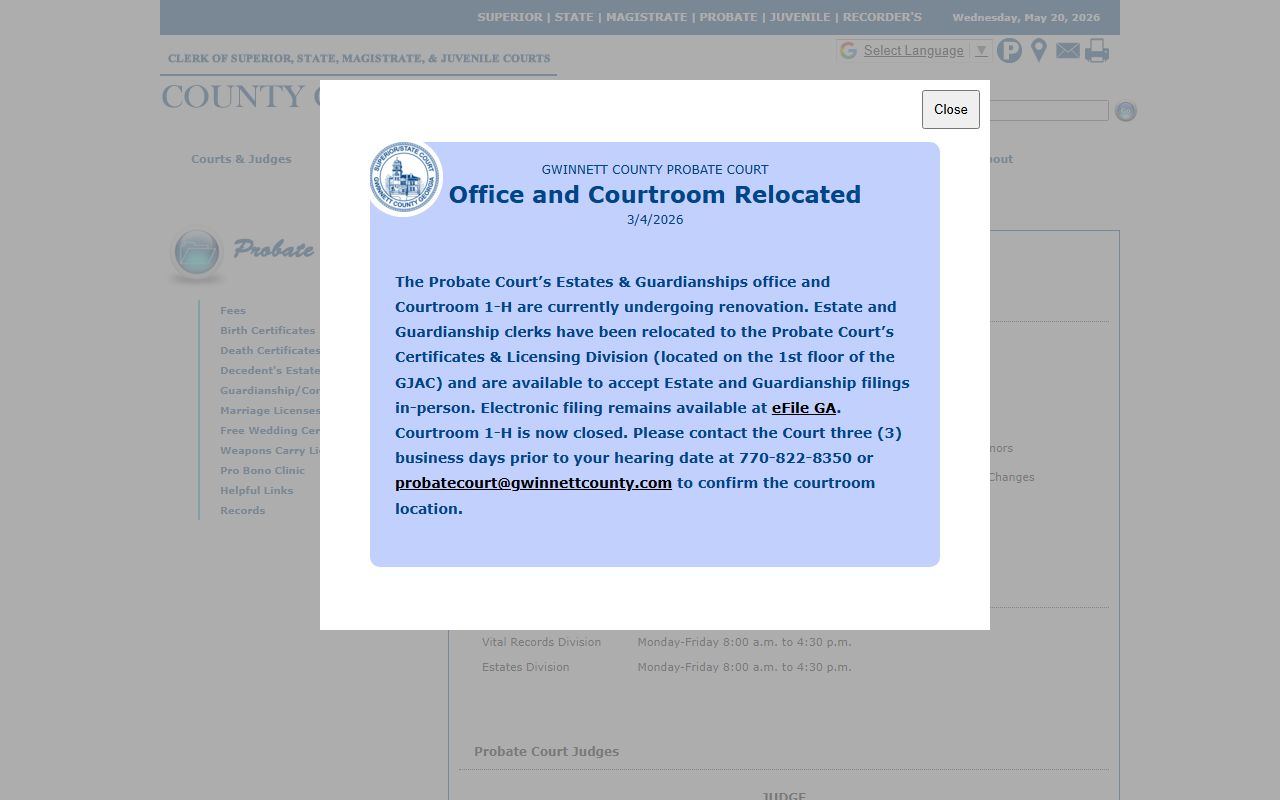
The Probate Court page is the right starting point for any estate, guardianship, marriage license, weapons carry license, or vital records question.
Key Probate Terms
Probate uses its own language. The list below covers the words a Gwinnett user is most likely to see.
- Testator
- The person who made the will.
- Executor
- The person named in a will to handle the estate.
- Administrator
- A person appointed by the court to handle an estate when there is no will.
- Intestate
- Dying without a will.
- Letters testamentary
- The court order that proves the executor's authority.
- Letters of administration
- The court order that proves the administrator's authority.
- Guardian
- A person who handles care or daily decisions for a minor or an adult who cannot do so.
- Conservator
- A person who manages money or property for someone under a court order.
- Year's support
- A Georgia procedure that can support a surviving spouse and minor children.
- Caveat
- An objection that triggers a contested probate case.
Confidential Probate Matters
Not every probate file is fully public. Mental health filings under Georgia Title 37, sensitive guardianship evaluations, and some minor-related records can be restricted. Adoption files are confidential under O.C.G.A. § 19-8-23. Probate users should not expect anonymous portal access to every protected document.
Note: Original wills should not be mailed or attached to email. Bring the original to the court counter or follow Probate Court written instructions for transmittal.
Gwinnett Probate Court Contact
Probate Court sits on the same campus as the rest of the trial courts. Visitors should expect courthouse security and should plan ahead for high-volume days, such as Monday mornings.
Marriage License Counter
Probate Court, Lawrenceville
By appointment where required
Common Probate Delays
Probate cases often slow down for the same reasons: missing heirs, unclear wills, contested caveats, real estate sales, creditor disputes, out of state property, minor heirs, bond issues, and incomplete inventories or annual returns. A representative who keeps deadlines, who maintains clean records, and who responds to court notices quickly can usually close the estate sooner. Letters testamentary and letters of administration are the documents banks, title companies, and insurers want to see, and missing those orders is a common reason a sale or a payout stalls.
Year's Support and Small Estates
Georgia probate practice includes procedures that can be simpler than full administration in qualifying cases. Year's support can move some assets to a surviving spouse and minor children without a full estate administration in the right circumstances. Small estate options can also apply when assets are modest. Eligibility is fact specific. A Gwinnett user planning to use either path should review the Probate Court page and consider a short consultation with a probate attorney before filing. Probate Court staff can answer process questions, but cannot give legal advice or recommend a result for a specific family situation.
Marriage and Vital Links
Marriage license details and the Probate Court vital records role are covered on the Gwinnett marriage and divorce records page. For Superior Court matters such as adoption involving Probate steps, also see court records. The state vital records portal at georgia.gov/request-vital-records can help when an applicant needs verification across counties.